

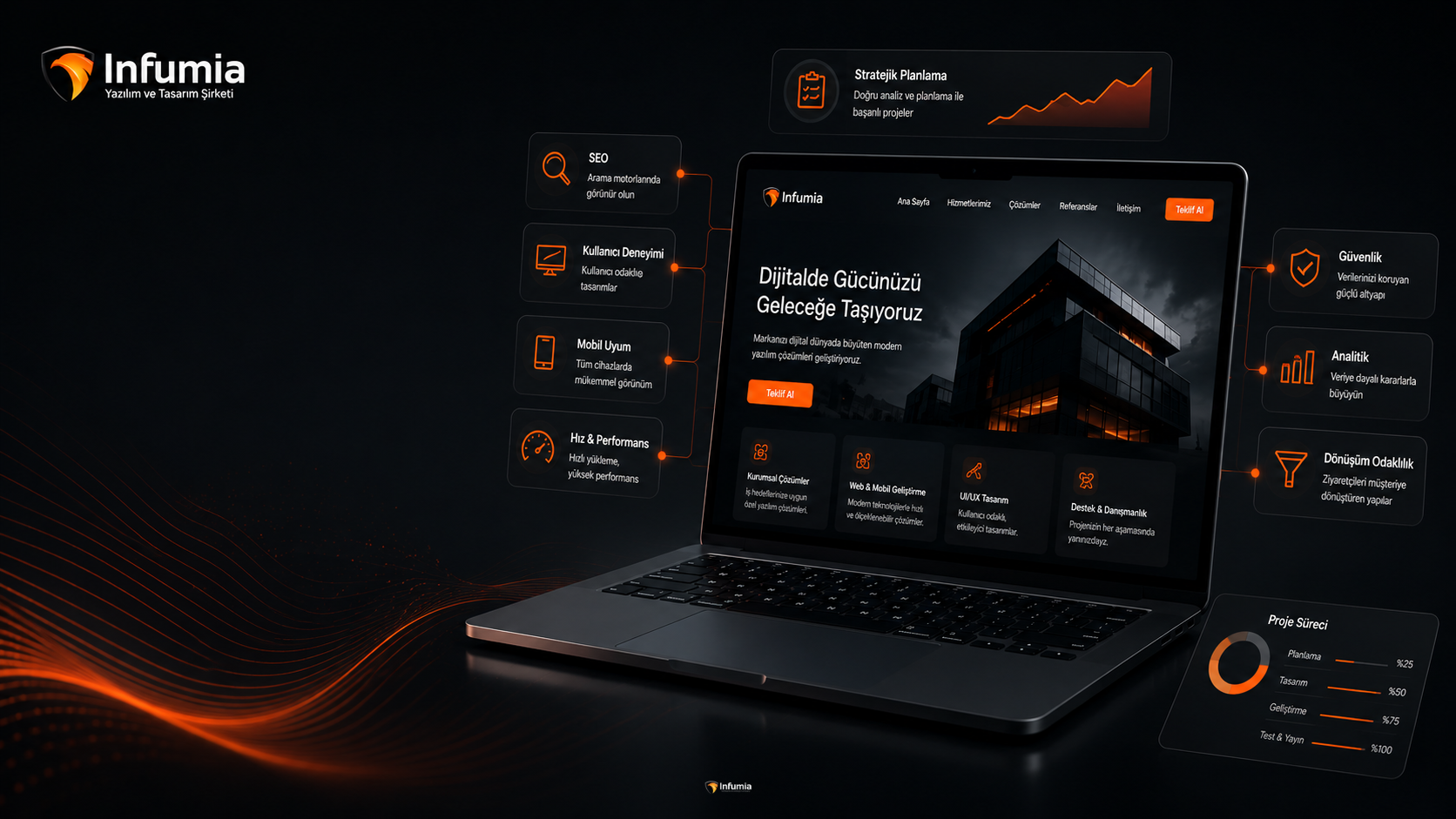
A company’s most important asset in the digital world is often created through its website. Potential customers, business partners, and investors examine your corporate website before making a decision about your company. For this reason, having a website built does not only mean having an internet site consisting of a few pages prepared; it means creating your brand’s digital identity in the correct format so that everyone can see it.
A professional corporate website makes your company/business look reliable. It explains your services correctly. It allows you to reach potential customers and speeds up your sales processes. However, in order to achieve a successful result, some basic points must be evaluated before the project begins.
1. The Purpose of the Website Should Be Determined
Before having a corporate website built, the purpose for which the website will be established should first be determined. Every company will not have the same expectations from its website. For this reason, you should determine your purpose when having a website built for your company/business.
The purposes of your website should be like the following:
- Introducing your company/business and your services
- Collecting quotation and contact requests from potential customers
- Providing communication by phone, email, or WhatsApp
- Displaying your products and solutions
- Reaching a customer base abroad (globally)
- Increasing brand reliability and promoting the brand
- Gaining organic visitors through SEO work
When the purpose of the project becomes clear, the design, content structure, and technical infrastructure can be planned much more accurately.
2. The Design Should Be Compatible With Your Corporate Identity
Website design should not be created only to look beautiful and impressive. The colors, typefaces (fonts), visuals, icons, and page layout/structure used should reflect the company’s corporate identity in a precise way.
The following are very important in professional corporate web design:
- Using brand colors consistently and clearly
- Using readable and modern typefaces (fonts)
- Ensuring visual and structural consistency between pages
- Avoiding unnecessary animations and effects
- Reflecting a corporate and trustworthy appearance
In general, using ready-made templates by only changing the logo and colors makes it difficult for your brand to differentiate itself from its competitors. For this reason, it is important for the design to be customized according to the company’s target audience and sector.
3. Mobile Compatibility Is a Priority
A significant portion of users access websites through mobile devices such as phones and tablets. For this reason, a corporate website should provide users with a seamless screen experience on all screen sizes.
On a mobile-compatible website:
- Texts should be easily readable without zooming in
- Buttons should be easy to click
- Menus should be comfortable and problem-free to use
- Visuals and texts should not overflow outside the screen
- Forms should be easy to complete on mobile devices
A website that looks good only on desktop but is difficult to use and view on mobile devices will cause visitor loss and advertising conversions will produce negative results.
4. The Website Should Open Quickly
Page loading speed is one of the most important factors that directly affects the user experience. A slow-loading website will cause users to leave the page quickly and potential customers to be lost.
The main reasons affecting website speed are as follows:
- Unoptimized visuals
- Poor-quality or insufficient hosting provider/infrastructure
- Unnecessary JavaScript and CSS files
- Excessive use of animations
- Incorrectly configured caching system
- Unoptimized database queries
- Websites created entirely with artificial intelligence
When having a corporate website built, attention should be paid not only to how the design looks, but also to how quickly the pages open.
5. The SEO Infrastructure Should Be Determined at the Beginning of the Project
Having a website prepared will not mean that it will automatically rank at the top of search engines. The SEO infrastructure must be created correctly while the project is being developed.
What are the features of an SEO-compatible corporate website:
- Understandable and short URL structures
- Editable page titles and meta descriptions
- Correct heading hierarchy
- Alternative text fields for visuals
- Mobile-compatible and fast pages
- XML sitemap
- Canonical URL support
- Structured data support
- A clean code structure that search engines can crawl
SEO should not be considered a feature that is added later. The website architecture, content, and technical infrastructure should be prepared in accordance with search engines from the very beginning.
6. Content Should Be Prepared Professionally
A beautiful design will not provide the expected result when it is supported by insufficient content. When potential customers and visitors enter your website, they should be able to quickly and easily understand what your company does, who it serves, and why they should choose you.
A corporate website generally includes the following pages:
- Homepage
- About Us
- Services or Solutions
- Products
- References or Projects
- Blog or Content Center
- Frequently Asked Questions
- Contact
The content should not consist only of general statements praising the company/business. It should focus on customers’ needs, the problems they experience, and the solutions offered by your company/business.
7. The User Experience Should Be Simple and Understandable
Visitors should reach the information they are looking for as quickly as possible. Complicated menus, unnecessary pages, and unclear buttons completely negatively affect the user experience. For this reason, visitors leave the website directly without spending time on it.
For a good user experience:
- The menu structure should be kept simple and clear
- Important services should be easily accessible
- Contact buttons should be visible
- Logical connections should be established between pages
- Quotation and contact forms should be as short as possible
- Call-to-action messages should be used in the correct areas
The website should not only inform the visitor. It should direct them toward a specific action such as making contact, requesting a quotation, or reviewing the services.
8. Security Measures Should Not Be Neglected
Corporate websites are among digital assets. For this reason, security should be one of the most important parts of the project.
The basic security measures are as follows:
- Use of an SSL certificate
- Secure administrator login system
- Regular software and plugin updates
- Strong password policies
- Authorization and user role management
- Regular backups
- Protection against spam and malicious traffic
- Secure storage of form data
Especially on websites with an administration panel, the infrastructure used must be kept up to date and security checks must be carried out regularly.
9. The Administration Panel Should Be Easy to Use
It is important that your company does not need the software company for every content change. News, blog content, products, services, and page texts should be editable instantly through a user-friendly administration panel.
The administration panel should include the following features:
- Page and content management
- Adding and editing blog posts
- Product and service management
- Uploading and editing visuals
- Editing SEO titles and meta descriptions
- Viewing form requests
- Multilingual management and the ability to add additional languages
- User and authorization management
An easily manageable system is very important for keeping your website up to date. In the long term, it will reduce operational costs and allow your visitors to spend enjoyable time on an up-to-date website.
10. Multilingual Support Structure
Multilingual support is very important for companies that serve abroad, have the potential to do so, or want to reach different markets. However, translating the texts alone is not sufficient.
Separately for each language:
- Page titles
- URL structures
- Meta descriptions
- Visual alternative texts
- Contact and service content
All of these should be manageable one by one. Automatic and uncontrolled translations may damage the company’s professional appearance.
11. Planning Contact and Conversion Areas
It is not enough for a corporate website to receive visitors on its own. The areas that will enable visitors to turn into potential customers must be prepared correctly.
The conversion areas that can be used will be as follows:
- Request a quotation forms
- Call by phone buttons
- WhatsApp contact links
- Appointment creation areas
- Email contact forms
- Product or service request forms
- Newsletter registration areas
It is important that forms are not extended with unnecessary questions and that only genuinely necessary information is requested from users.
12. Analytics and Measurement Tools
After the website is published, how users use the website should be monitored by professionals. Which pages are visited more frequently, where users come from, and in which areas they leave the website should be measured.
What are the basic data that should be monitored:
- Total number of visitors
- Organic search traffic
- Most visited pages
- Form submissions
- Phone and WhatsApp clicks
- Time spent on the page
- Conversion rates
These are among the topics included. This data allows the website to be improved over time and digital marketing investments to be managed more efficiently.
13. Technical Support and Maintenance Process
A corporate website project should not be considered completed when the website is published. Software updates, security checks, backups, and performance improvements should continue regularly.
The following questions should be asked to the company from which you will receive services:
- Is technical support provided after publication?
- Who will carry out the updates?
- Are regular backups performed?
- What is the response time in the event of a possible problem?
- Are hosting and server management included in the service?
- How are additional development requests priced?
The scope of the maintenance service should be clearly determined before the project begins.
14. Ownership of the Website Should Belong to the Company
Clarity should be provided regarding ownership of the domain name, hosting account, source codes, administration panel, and other services used.
Your company should have access to the following assets:
- Domain name management account
- Hosting and server account
- Administration panels
- Analytics accounts
- Corporate email management
- Source codes and project files
- Backup files
Having these access rights only with the service provider may cause serious problems in later periods.
15. A Decision Should Not Be Made Based Only on Price
Corporate website prices may vary according to the scope of the project, custom design, number of pages, multilingual support, administration panel, integrations, and technical requirements.
Although choosing the company offering the lowest price may seem advantageous in the short term, it may cost more in the long term due to poor performance, security vulnerabilities, insufficient support, and redevelopment costs.
When comparing proposals, attention should be paid not only to the total price, but also to the scope of the service offered and the features to be delivered.
What questions should be asked when choosing a corporate website company:
- Will the design be prepared specifically for the company?
- Are mobile compatibility works included?
- Will the SEO infrastructure be established?
- Will there be an administration panel?
- Will website speed optimization be carried out?
- Will security and backup services be provided?
- Can multilingual support be added?
- Will the source codes and administration access be delivered?
- How long will post-publication support continue?
- What is the estimated delivery time of the project?
Conclusion
Having a corporate website built is a long-term and professional investment made for the reputation of your company/business in the digital world.
Correctly determining the needs before the project begins, clearly writing the scope of the service, and working with an experienced software company prevent many problems that may occur in the future.
As Infumia, we develop fast, secure, mobile-compatible corporate web solutions with a strong SEO infrastructure, customized according to the needs of companies. You can contact us to create a professional corporate website for your business or renew your existing website.
A professional corporate website makes your company/business look reliable. It explains your services correctly. It allows you to reach potential customers and speeds up your sales processes. However, in order to achieve a successful result, some basic points must be evaluated before the project begins.
1. The Purpose of the Website Should Be Determined
Before having a corporate website built, the purpose for which the website will be established should first be determined. Every company will not have the same expectations from its website. For this reason, you should determine your purpose when having a website built for your company/business.
The purposes of your website should be like the following:
- Introducing your company/business and your services
- Collecting quotation and contact requests from potential customers
- Providing communication by phone, email, or WhatsApp
- Displaying your products and solutions
- Reaching a customer base abroad (globally)
- Increasing brand reliability and promoting the brand
- Gaining organic visitors through SEO work
When the purpose of the project becomes clear, the design, content structure, and technical infrastructure can be planned much more accurately.
2. The Design Should Be Compatible With Your Corporate Identity
Website design should not be created only to look beautiful and impressive. The colors, typefaces (fonts), visuals, icons, and page layout/structure used should reflect the company’s corporate identity in a precise way.
The following are very important in professional corporate web design:
- Using brand colors consistently and clearly
- Using readable and modern typefaces (fonts)
- Ensuring visual and structural consistency between pages
- Avoiding unnecessary animations and effects
- Reflecting a corporate and trustworthy appearance
In general, using ready-made templates by only changing the logo and colors makes it difficult for your brand to differentiate itself from its competitors. For this reason, it is important for the design to be customized according to the company’s target audience and sector.
3. Mobile Compatibility Is a Priority
A significant portion of users access websites through mobile devices such as phones and tablets. For this reason, a corporate website should provide users with a seamless screen experience on all screen sizes.
On a mobile-compatible website:
- Texts should be easily readable without zooming in
- Buttons should be easy to click
- Menus should be comfortable and problem-free to use
- Visuals and texts should not overflow outside the screen
- Forms should be easy to complete on mobile devices
A website that looks good only on desktop but is difficult to use and view on mobile devices will cause visitor loss and advertising conversions will produce negative results.
4. The Website Should Open Quickly
Page loading speed is one of the most important factors that directly affects the user experience. A slow-loading website will cause users to leave the page quickly and potential customers to be lost.
The main reasons affecting website speed are as follows:
- Unoptimized visuals
- Poor-quality or insufficient hosting provider/infrastructure
- Unnecessary JavaScript and CSS files
- Excessive use of animations
- Incorrectly configured caching system
- Unoptimized database queries
- Websites created entirely with artificial intelligence
When having a corporate website built, attention should be paid not only to how the design looks, but also to how quickly the pages open.
5. The SEO Infrastructure Should Be Determined at the Beginning of the Project
Having a website prepared will not mean that it will automatically rank at the top of search engines. The SEO infrastructure must be created correctly while the project is being developed.
What are the features of an SEO-compatible corporate website:
- Understandable and short URL structures
- Editable page titles and meta descriptions
- Correct heading hierarchy
- Alternative text fields for visuals
- Mobile-compatible and fast pages
- XML sitemap
- Canonical URL support
- Structured data support
- A clean code structure that search engines can crawl
SEO should not be considered a feature that is added later. The website architecture, content, and technical infrastructure should be prepared in accordance with search engines from the very beginning.
6. Content Should Be Prepared Professionally
A beautiful design will not provide the expected result when it is supported by insufficient content. When potential customers and visitors enter your website, they should be able to quickly and easily understand what your company does, who it serves, and why they should choose you.
A corporate website generally includes the following pages:
- Homepage
- About Us
- Services or Solutions
- Products
- References or Projects
- Blog or Content Center
- Frequently Asked Questions
- Contact
The content should not consist only of general statements praising the company/business. It should focus on customers’ needs, the problems they experience, and the solutions offered by your company/business.
7. The User Experience Should Be Simple and Understandable
Visitors should reach the information they are looking for as quickly as possible. Complicated menus, unnecessary pages, and unclear buttons completely negatively affect the user experience. For this reason, visitors leave the website directly without spending time on it.
For a good user experience:
- The menu structure should be kept simple and clear
- Important services should be easily accessible
- Contact buttons should be visible
- Logical connections should be established between pages
- Quotation and contact forms should be as short as possible
- Call-to-action messages should be used in the correct areas
The website should not only inform the visitor. It should direct them toward a specific action such as making contact, requesting a quotation, or reviewing the services.
8. Security Measures Should Not Be Neglected
Corporate websites are among digital assets. For this reason, security should be one of the most important parts of the project.
The basic security measures are as follows:
- Use of an SSL certificate
- Secure administrator login system
- Regular software and plugin updates
- Strong password policies
- Authorization and user role management
- Regular backups
- Protection against spam and malicious traffic
- Secure storage of form data
Especially on websites with an administration panel, the infrastructure used must be kept up to date and security checks must be carried out regularly.
9. The Administration Panel Should Be Easy to Use
It is important that your company does not need the software company for every content change. News, blog content, products, services, and page texts should be editable instantly through a user-friendly administration panel.
The administration panel should include the following features:
- Page and content management
- Adding and editing blog posts
- Product and service management
- Uploading and editing visuals
- Editing SEO titles and meta descriptions
- Viewing form requests
- Multilingual management and the ability to add additional languages
- User and authorization management
An easily manageable system is very important for keeping your website up to date. In the long term, it will reduce operational costs and allow your visitors to spend enjoyable time on an up-to-date website.
10. Multilingual Support Structure
Multilingual support is very important for companies that serve abroad, have the potential to do so, or want to reach different markets. However, translating the texts alone is not sufficient.
Separately for each language:
- Page titles
- URL structures
- Meta descriptions
- Visual alternative texts
- Contact and service content
All of these should be manageable one by one. Automatic and uncontrolled translations may damage the company’s professional appearance.
11. Planning Contact and Conversion Areas
It is not enough for a corporate website to receive visitors on its own. The areas that will enable visitors to turn into potential customers must be prepared correctly.
The conversion areas that can be used will be as follows:
- Request a quotation forms
- Call by phone buttons
- WhatsApp contact links
- Appointment creation areas
- Email contact forms
- Product or service request forms
- Newsletter registration areas
It is important that forms are not extended with unnecessary questions and that only genuinely necessary information is requested from users.
12. Analytics and Measurement Tools
After the website is published, how users use the website should be monitored by professionals. Which pages are visited more frequently, where users come from, and in which areas they leave the website should be measured.
What are the basic data that should be monitored:
- Total number of visitors
- Organic search traffic
- Most visited pages
- Form submissions
- Phone and WhatsApp clicks
- Time spent on the page
- Conversion rates
These are among the topics included. This data allows the website to be improved over time and digital marketing investments to be managed more efficiently.
13. Technical Support and Maintenance Process
A corporate website project should not be considered completed when the website is published. Software updates, security checks, backups, and performance improvements should continue regularly.
The following questions should be asked to the company from which you will receive services:
- Is technical support provided after publication?
- Who will carry out the updates?
- Are regular backups performed?
- What is the response time in the event of a possible problem?
- Are hosting and server management included in the service?
- How are additional development requests priced?
The scope of the maintenance service should be clearly determined before the project begins.
14. Ownership of the Website Should Belong to the Company
Clarity should be provided regarding ownership of the domain name, hosting account, source codes, administration panel, and other services used.
Your company should have access to the following assets:
- Domain name management account
- Hosting and server account
- Administration panels
- Analytics accounts
- Corporate email management
- Source codes and project files
- Backup files
Having these access rights only with the service provider may cause serious problems in later periods.
15. A Decision Should Not Be Made Based Only on Price
Corporate website prices may vary according to the scope of the project, custom design, number of pages, multilingual support, administration panel, integrations, and technical requirements.
Although choosing the company offering the lowest price may seem advantageous in the short term, it may cost more in the long term due to poor performance, security vulnerabilities, insufficient support, and redevelopment costs.
When comparing proposals, attention should be paid not only to the total price, but also to the scope of the service offered and the features to be delivered.
What questions should be asked when choosing a corporate website company:
- Will the design be prepared specifically for the company?
- Are mobile compatibility works included?
- Will the SEO infrastructure be established?
- Will there be an administration panel?
- Will website speed optimization be carried out?
- Will security and backup services be provided?
- Can multilingual support be added?
- Will the source codes and administration access be delivered?
- How long will post-publication support continue?
- What is the estimated delivery time of the project?
Conclusion
Having a corporate website built is a long-term and professional investment made for the reputation of your company/business in the digital world.
Correctly determining the needs before the project begins, clearly writing the scope of the service, and working with an experienced software company prevent many problems that may occur in the future.
As Infumia, we develop fast, secure, mobile-compatible corporate web solutions with a strong SEO infrastructure, customized according to the needs of companies. You can contact us to create a professional corporate website for your business or renew your existing website.